Tag: evolution

  • Natural v. Artificial Selection

    Natural v. Artificial Selection

    Last week I published a short article in Molecular Ecology on evidence for natural selection. It has proven difficult to show natural selection occurring in real time in wild populations. New approaches may help, and these are being pioneered in studies of Soay sheep. While commenting on these new approaches, I make several general points about the evidential case for natural selection.

    Perhaps the more broadly interesting of these is a critique of the argument by analogy to natural selection. I suggest that, although widely used, the analogy has severe limitations. You can read this critique from the second to the seventh paragraph of my article, which is available open access here.

  • A new talk on Darwin’s abominable mystery

    A new talk on Darwin’s abominable mystery

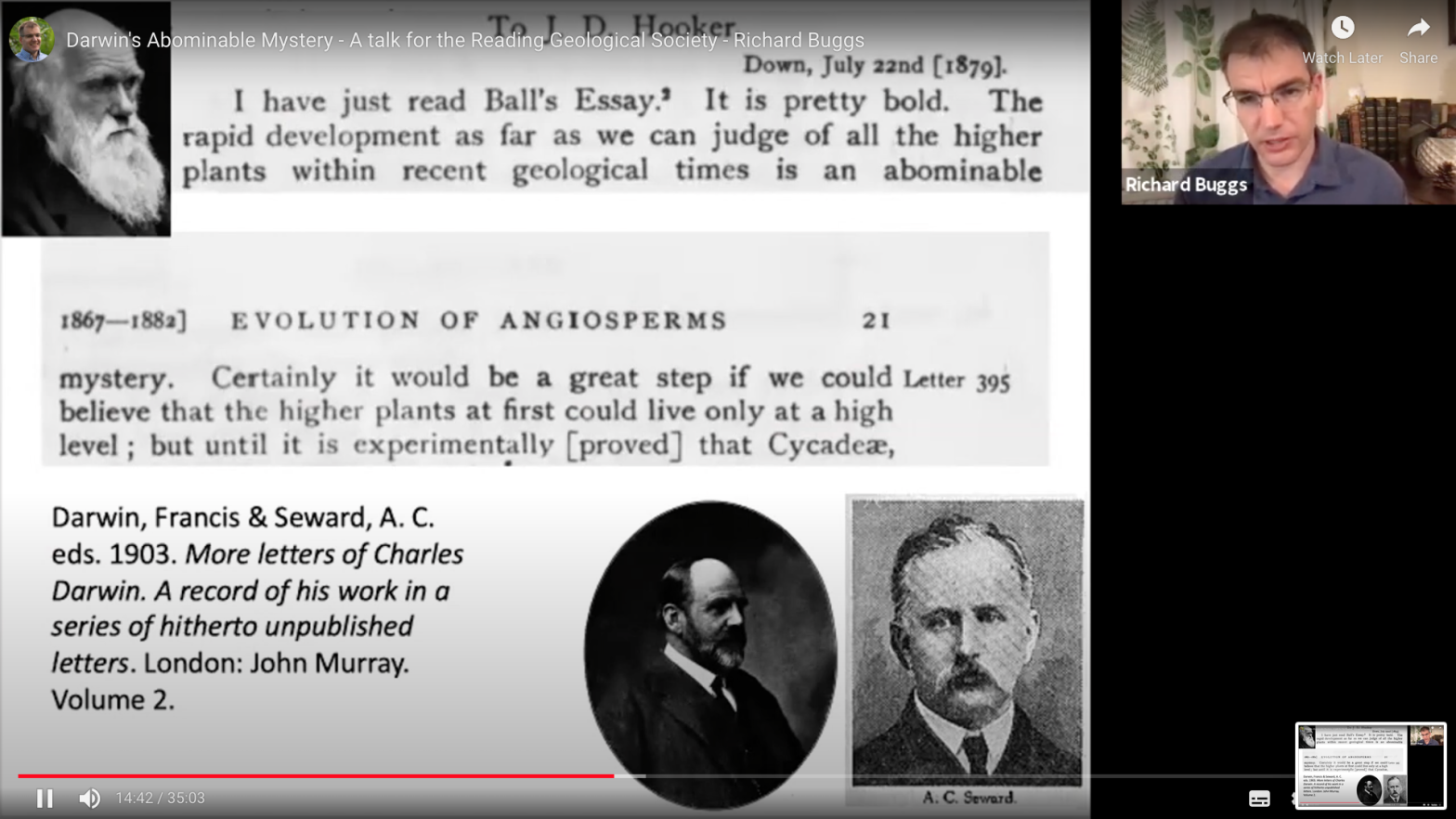
    Last evening I spoke for the Reading Geological Society on Darwin’s “abominable mystery”: the origin of flowering plants. My previous talks and publications (here and here) on this topic have focused mainly on the nineteenth century. In this new talk, I outlined twentieth century efforts to solve the mystery, which is something I continue to research.

    Here is the talk:

  • Adam and Eve: lessons learned

    Adam and Eve: lessons learned

    This blog was first posted at Nature Ecology & Evolution Community on 14 April 2018

    Preliminary conclusions about the possibility of a short, sharp human bottleneck

    A few months ago I asked this community if modern genome science had tested an “Adam and Eve” hypothesis that the human lineage has passed through short, sharp bottleneck of two at some point in its history. While this question may sound bizarre to some, it is one that is often asked by those with a background in Abrahamic faiths. My post has therefore been taken up and discussed extensively on the Skeptical Zone and Biologos Forum over the past few months, as well as by various blogs.

    The claim that genomic methods have been used to test and reject an “Adam and Eve” hypothesis was central to the recent book Adam and the Genome. My post, which critiqued the arguments made in that book, has received a broad level of explicit or tacit agreement in subsequent online discussions. More adequate ways of testing the hypothesis have been suggested, and preliminary results have been obtained.

    Here I will share some of the lessons I have learned from these discussions and from further reading. These are somewhat tentative, and not all are based on published peer reviewed literature. In a short blog I cannot do not do full justice to all the contributions that have been made by various scientists within the online fora, so as far as possible I will try to provide direct links to the contributions of others.

    Here are the lessons I have learned so far:

    (more…)
  • “Abundant bioactivity” of random DNA sequences?

    This blog was written for the Nature Ecology and Evolution Community where it is posted here.

    Probing the claims of a recent study

    Readers of this blog will be aware of the recent Nature Ecology and Evolution paper entitled “Random sequences are an abundant source of bioactive RNAs or peptides”. Rafik Neme, the first author, posted an engaging Behind the Paper blog here.

    On a quick look, I thought the study might be the beginnings of the solution to the mystery of orphan genes. (I posted about orphan genes here a few months ago.) The paper appears to demonstrate that an unexpectedly high percentage of random 150 base-pair DNA sequences are functional when expressed in E. coli. If true, this would suggest that de novo gene evolution could occur easily from junk DNA. (more…)

  • The evolutionary mystery of orphan genes

    Every newly sequenced genome contains genes with no traceable evolutionary descent – the ash genome was no exception

    This week in Nature I and my co-authors published the ash tree genome. Within it we found 38,852 protein-coding genes. Of these one quarter (9,604) were unique to ash. On the basis of our research so far, I cannot suggest shared evolutionary ancestry for these genes with those in ten other plants we compared ash to: coffee, grape, loblolly pine, monkey flower, poplar, tomato, Amborella, Arabidopsis, barrel medic, and bladderwort. This is despite the fact that monkey flower and bladderwort are in the same taxonomic order (Lamiales) as ash. (more…)

  • Phenotypic plasticity drives cichlid radiations?

    At the Royal Society last month, I was listening to proponents of the “extended evolutionary synthesis” (EES). Patrick Goymer has blogged this meeting for Nature Ecology & Evolution, and tweets from it can be found on Storify. The debates have rumbled on in the back of my mind since, especially the contention that phenotypic plasticity is too neglected in evolutionary biology. I was therefore fascinated to stumble upon a paper in press at Molecular Ecology which suggests an impressive case of phenotypic plasticity accelerating evolution. Ralf Schneider and Axel Meyer argue that rapid, convergent radiations of cichlid fish in East African Lakes have been greatly facilitated by morphological plasticity, and its fixation as regulatory networks degenerate. “The cichlids of Africa’s lakes impress us mightily with what evolution can do in a short space of time”, wrote Richard Dawkins in The Greatest Show on Earth (Bantam Press, 2009). Will these radiations become textbook examples of the EES in action?

    This blog was first posted here at Nature Ecology & Evolution Community on 8 December 2016