Category: Darwin

  • Public lecture “Trees of Life: Do they exist?”

    Public lecture “Trees of Life: Do they exist?”

    In gave my inaugural lecture as Professor of Evolutionary Genomics at Queen Mary University of London on 16th November 2022, the film of which can be viewed below.

    Inaugural lectures are a chance to give a personal view on one’s research field, at a level that will be understood by the whole university and the general public.

    My Vice-Principal asked me to be more personal than usual in this inaugural, speaking about my Christian faith as well as my research as a biologist.

    I decided to do this by placing side-by-side “tree-of-life” concepts from the Bible and from The Origin of Species. By comparing and contrasting the evidence for these very different trees of life, I tried to help the audience understand how I think through things as both a biologist and a Christian.

    Whether or not this worked, you can judge for yourself.

    The lecture drew on articles I have published in Nature Ecology and EvolutionNature Plants, and American Journal of Botany. I describe work by others in Nature and Nature CommunicationsThe Origin of Species provided my starting point on Darwin’s tree of life simile. The works of Richard Dawkins, especially The Greatest Show on Earth and The God Delusion, provided helpful material in both sections of the lecture. On the Biblical tree of life, I used an argument by Peter J. Williams, (whose research recently featured in Nature) developed in his book Can We Trust the Gospels? I also refer to research by Elizabeth Barnes on inclusion in the biological sciences.

    I have been a full professor at Queen Mary for over four years now, but there is a back-log of inaugural lectures, and many never happen at all. So it was a great privilege to be invited to give this.

  • Natural v. Artificial Selection

    Natural v. Artificial Selection

    Last week I published a short article in Molecular Ecology on evidence for natural selection. It has proven difficult to show natural selection occurring in real time in wild populations. New approaches may help, and these are being pioneered in studies of Soay sheep. While commenting on these new approaches, I make several general points about the evidential case for natural selection.

    Perhaps the more broadly interesting of these is a critique of the argument by analogy to natural selection. I suggest that, although widely used, the analogy has severe limitations. You can read this critique from the second to the seventh paragraph of my article, which is available open access here.

  • A new talk on Darwin’s abominable mystery

    A new talk on Darwin’s abominable mystery

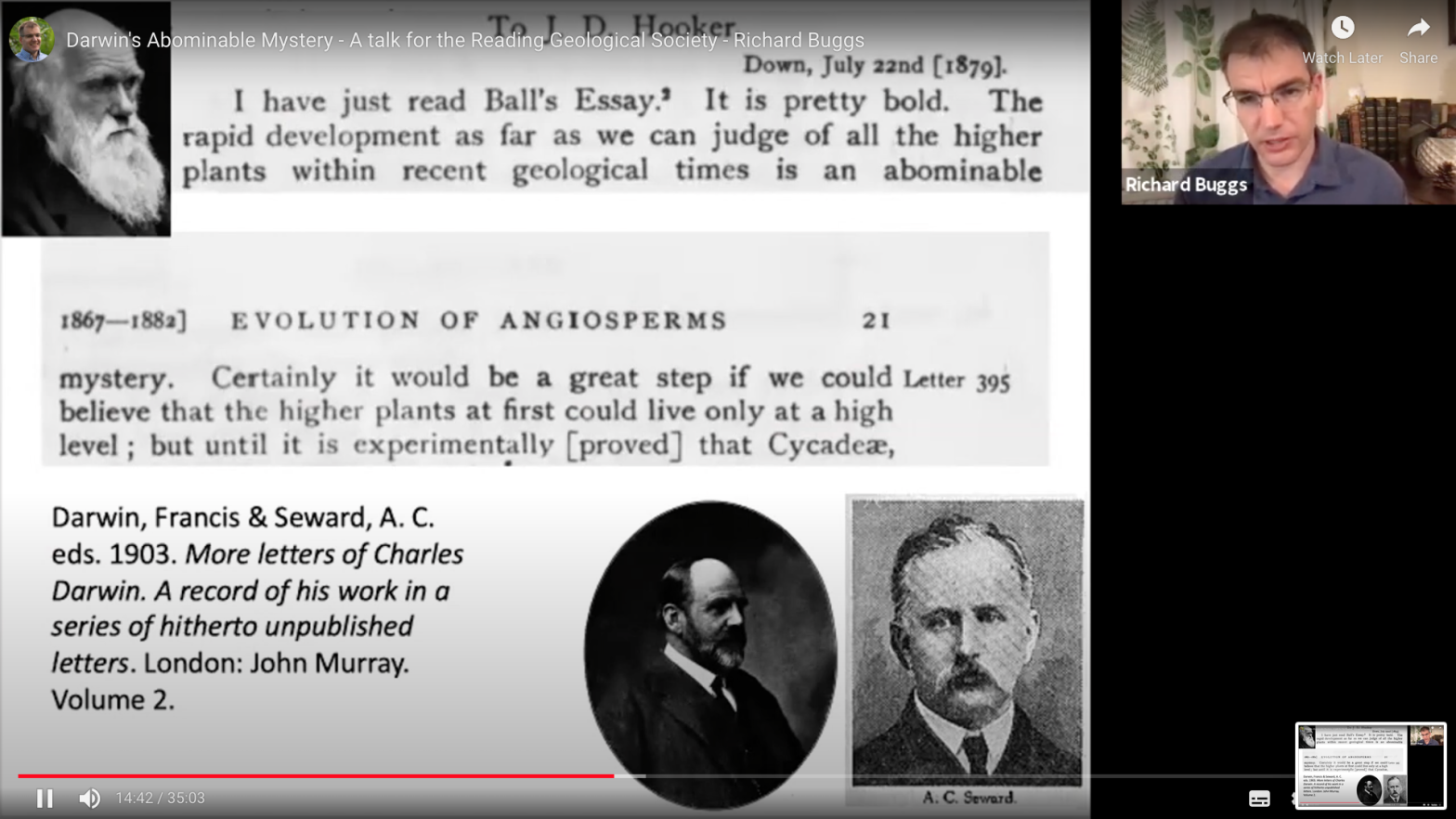
    Last evening I spoke for the Reading Geological Society on Darwin’s “abominable mystery”: the origin of flowering plants. My previous talks and publications (here and here) on this topic have focused mainly on the nineteenth century. In this new talk, I outlined twentieth century efforts to solve the mystery, which is something I continue to research.

    Here is the talk:

  • Video: More than evolution

    Video: More than evolution

    Here is a 20 minute lockdown video I published on YouTube a few days ago. In it, I make one major point: it is as hard to be an atheist today as it was 2400 years ago. In fact, a little harder.

    I have seen a few responses to this video by atheists since I put it up, but so far, none of these have addressed the major point I am making. I hope someone will soon.

    The material in this video is similar to a blog I posted a year ago: “Did Darwin make atheism credible“. If you prefer text to video, please do take a look there.

  • What was Darwin thinking? The origin of his ‘abominable mystery’

    What was Darwin thinking? The origin of his ‘abominable mystery’

    Happy Darwin Day 2021! This blog is about Darwin’s thought in the final years of his life, written for the Nature Ecology and Evolution community and re-published here.

    Back in 2012, The Natural History Museum of Milan invited me to give a talk for their Darwin Day symposium. Predictably for a botanist, I took the topic of Darwin’s “abominable mystery”. In 1879 Darwin famously wrote that “The rapid development as far as we can judge of all the higher plants within recent geological times is an abominable mystery.”

    That invitation got me started on nine years’ of research on the historical background of Darwin’s famous epithet for the plant fossil record. In 2017 I published some preliminary findings in Nature Ecology and Evolution. I published more detailed just a few days ago in The American Journal of Botany, with a paper titled: “The origin of Darwin’s abominable mystery“.

    This new paper majors on Darwin’s understanding of plant systematics and paleobotany in the late 1870s. I presented new evidence that for Darwin the ‘abominable mystery’ was about the sudden appearance of dicotyledonous fossils in the Cretaceous. This is different to today’s understanding that the abominable mystery applies to all angiosperms.

    This work caught the attention of the BBC science correspondent Helen Briggs, who published a thought-provoking article that was translated into Portuguese, Spanish, Indonesian, Chinese, and Italian. The Times of London also picked up on the story.

    Strangely enough, the issue of dicotyledons versus angiosperms was not the one that captured public attention.

    Darwin’s forgotten opponent

    It was a forgotten opponent of Darwin who gained the limelight. I stumbled upon him in the library of Kew Gardens, first as a citation in an 1888 textbook of paleobotany, and again soon after when a librarian emerged from the basement bearing a fragile pamphlet, printed in 1877: “Fossil Plants and their Testimony in Reference to the Doctrine of Evolution”.

    The pamphlet was a reprint of two scientific lectures. One delivered in 1876 made a detailed case that the fossil record of plants does not fit with Darwinian evolution, and instead could be explained by divine intervention. Especially the sudden appearance of the dicots in the Cretaceous. The author was William Carruthers.

    Could William Carruthers have contributed to making the plant fossil record an abomination to Darwin in 1879? The timing of his lecture seemed to make it likely, but could I make a direct link?

    I could not see his lecture mentioned anywhere in Darwin’s writings. But I pieced together three pieces of evidence that Darwin had been aware of it.

    Firstly, Carruthers’ 1876 lecture was reported at length in The Times immediately after he gave it, and Darwin was in the habit of reading The Times after lunch everyday. Darwin would hardly have missed a long article with the headline “Plant Evolution”.

    Secondly, among Darwin’s cuttings I found a copy of Carruthers’ lecture published in the Gardener’s Chronicle, one of Darwin’s favourite magazines.

    Thirdly, again among Darwin’s cuttings, I found a response to Carruthers’ lecture published by Nature in 1877.

    Together, these make a strong case that Darwin was aware of Carruthers’ view, and the wide publicity it gained.

    Uncomfortably for Darwin, William Carruthers was more qualified to speak about the plant fossil record than he was. Carruthers was the Keeper of Botany at the British Museum (Natural History) and had published many papers on paleobotany. Like Darwin, he was a Fellow of the Royal Society.

    To add piquancy, Carruthers was already out of favour with Darwin’s circle of friends. He had twice stymied their attempts to move herbarium collections from the British Museum to Kew. In 1874, Joseph Hooker described Carruthers to Darwin as an “Owenised Scotchman”, in reference to Darwin’s arch-enemy Richard Owen, a close colleague of Carruthers.

    This was not someone whom Darwin wanted to enter into a debate with, in an area where he had no ready answers.

    So Darwin’s term “abominable mystery” isn’t just about his perplexity with the plant fossil record. It also about his discomforting by his opponents.

    Do I blame journalists for passing over the technical detail of my paper to focus on this side of the story? I can’t say I do. I find it pretty interesting too.