Author: Richard Buggs

  • More on human-chimp genomic similarity

    More on human-chimp genomic similarity

    The Live Science website has just published an article on Do humans and chimps really share nearly 99% of their DNA? subtitled: “The frequently cited 99% similarity between human and chimp DNA overlooks key differences in the genomes.

    This includes an email interview with a leading figure in the field, Tomas Marques-Bonet. Tomas was the final author of the 2013 Nature paper Great ape genetic diversity and population history. Since then he has published numerous papers on both ape and human genomes.

    The Live Science article reports:

    But the 99% figure is misleading because it focuses on stretches of DNA where the human and chimp genomes can be directly aligned and ignores sections of the genomes that are difficult to compare, Tomas Marques-Bonet, head of the Comparative Genomics group at the Institute of Evolutionary Biology (CSIC/UPF) in Barcelona, Spain, told Live Science in an email.


    Sections of human DNA without a clear counterpart in chimp DNA make up approximately 15% to 20% of the genome, Marques-Bonet said. For example, some bits of DNA are present in one species but missing in the other; these are known as “insertions and deletions.” In the course of evolution from a common ancestor, some pieces of DNA in one species broke off and reattached elsewhere along the chromosome.


    So, while earlier studies suggested a 98% to 99% similarity, comparisons that include harder-to-align regions push that difference closer to 5% to 10%, Marques-Bonet said. “And if we account for the regions still too complex to align properly with current technology, the true overall difference is likely to exceed 10%,” he said.


    In fact, a 2025 study found that human and chimpanzee genomes are approximately 15% different when compared directly and completely. But if this direct method is used, then there is even a lot of variability within species themselves — up to 9% among chimpanzees, the 2025 study found.”

    Another article reporting Tomas Marques-Bonet’s comments can be found on primatology.net.

    For more on the 2025 study, see my earlier blog post here.

  • How much of a human genome is identical to a chimpanzee genome?

    How much of a human genome is identical to a chimpanzee genome?

    Back in 2018 I wrote a blog post entitled “How similar are human and chimpanzee genomes?” This reported my analysis of the data available at the time, concluding:

    “The percentage of nucleotides in the human genome that had one-to-one exact matches in the chimpanzee genome was 82.34%.”

    This was based on human and chimpanzee genome assemblies hg38 and pantro6.

    Critics of my analysis said that this figure could not be trusted because both the human and chimpanzee genome assemblies were incomplete at the time.

    Since then, much more complete genome assemblies have been published for both species.

    Last month, the Nature paper “Complete sequencing of ape genomes” reported various comparisons of telomere-to-telomere genome assemblies.

    When the latest human genome assembly was used as a target, and the latest chimpanzee assembly was aligned to it, the authors report gap divergence of 13.3% and single nucleotide variant divergence of 1.6% (these results can be found in Supplementary Figure III.11 and 12 respectively, for hg0002 vs PanTro3).

    As I understand their methods, gap divergence was based on counting base (A, T, G or C) positions in the human genome that have no aligning base from the chimp genome in the whole genome alignment. Single nucleotide variant divergence was based on counting bases that align to a different base (e.g. an A aligning to a T). The authors calculated these divergences for each 1 million base segment of the human genome then averaged them all to get a genome-wide figure.

    Adding the average gap divergence and average single nucleotide variant divergence together gives a total difference of 14.9%.

    Thus, as I understand it, for the latest assemblies, 85.1 % of the nucleotides in the human genome have one-to-one exact matches in the chimpanzee genome.

    This is clearly a slightly higher figure than the 82.3% that I calculated in 2018. But it is not far off.

    The new result of 85.1% is just for autosomes (non-sex chromosomes). The same Nature paper reports 4.18% and 75.6% gap divergence and 1.15% and 3.98% single nucleotide variant divergence for X and Y chromosomes respectively.

    At some point I would like to repeat exactly the same analysis as I did in 2018 on the 2025 data. But until then, the figures reported by the authors of the Nature paper provide a helpful comparison.

  • Interview on science and faith

    Interview on science and faith

    For a summary of my group’s latest research on UK broadleaved trees, and a discussion of the positive interaction between my science and Christianity, listen to this week’s episode of the ECO Chamber podcast, from the ENDS Report. My interview starts 30 minutes in.

    Also on Spotify, Apple, Podbean.

  • Science moves closer to Adam and Eve?

    Science moves closer to Adam and Eve?

    Yesterday, the journal Science published a study providing evidence that humans are descended from very small population. The authors detect a bottleneck lasting about 100,000 years with an average effective population size of about 1280. They date this to about 813,000 to 930,000 years ago, placing it before the divergence of Neandertals and Denisovans from modern humans. This coincides with a large gap in the hominin fossil record. They suggest it is the period in which the human chromosome number of 23 originated.

    Such a bottleneck has not been detected before. Effective population sizes did not fall below 10,000 in previous genome analyses. The authors of the new study provide simulations to show that their software is better at detecting bottlenecks than older software.

    A few years ago, I was involved in an extensive discussion with other Christian biologists on whether the (then current) estimates, which never dropped below 10,000, disproved the hypothesis that human descend from a single couple. Representatives of the organisation Biologos argued that they did. I argued that they did not, because the methods used were simply unable to detect short sharp bottlenecks. Eventually, a measure of consensus emerged. We agreed that genomics does not rule out a single couple as the sole progenitors of humans. The organisation Biologos adopted a new position on the issue: that Adam and Eve are only ruled out in the last 500,000 years but not before that.

    The methods used in the study published in Science yesterday are similar to the older methods in that they also cannot detect short sharp bottlenecks. They rely on the assumption that the human population size was stable over time windows lasting many generations, in order to calculate an effective population size for that time window. Thus, a bottleneck of two is not ruled out by their methods. In some ways, the single-couple hypothesis becomes more plausible given the new evidence for a prolonged bottleneck with an average effective population size of about 1280.

    The new study, and the discussion going on around it, are also helpful reminders that no studies estimating past effective population sizes should be taken as absolute truth. The authors begin their study by saying “ancient population size history of the genus Homo during the Pleistocene is still poorly known” and “a new approach is needed to improve the inference accuracy of population size history.” This was of course true in 2018, when I was previously discussing this issue with Christian biologist. But this caveat was not as clearly stated in the scientific literature at that time, which made it hard to persuade some layperson onlookers that caution was needed. It is an unfortunate feature of the scientific literature that publicly accessible critiques of methods are often only available once a new improved replacement is found.

    Christians must be cautious about how they interact with studies exploring past human effective population sizes from genomes. Such methods are not able to either prove or disprove the hypothesis of Adam and Eve. But none-the-less it is fascinating to see the science appearing to move towards, and not away from, this hypothesis.


  • Public lecture “Trees of Life: Do they exist?”

    Public lecture “Trees of Life: Do they exist?”

    In gave my inaugural lecture as Professor of Evolutionary Genomics at Queen Mary University of London on 16th November 2022, the film of which can be viewed below.

    Inaugural lectures are a chance to give a personal view on one’s research field, at a level that will be understood by the whole university and the general public.

    My Vice-Principal asked me to be more personal than usual in this inaugural, speaking about my Christian faith as well as my research as a biologist.

    I decided to do this by placing side-by-side “tree-of-life” concepts from the Bible and from The Origin of Species. By comparing and contrasting the evidence for these very different trees of life, I tried to help the audience understand how I think through things as both a biologist and a Christian.

    Whether or not this worked, you can judge for yourself.

    The lecture drew on articles I have published in Nature Ecology and EvolutionNature Plants, and American Journal of Botany. I describe work by others in Nature and Nature CommunicationsThe Origin of Species provided my starting point on Darwin’s tree of life simile. The works of Richard Dawkins, especially The Greatest Show on Earth and The God Delusion, provided helpful material in both sections of the lecture. On the Biblical tree of life, I used an argument by Peter J. Williams, (whose research recently featured in Nature) developed in his book Can We Trust the Gospels? I also refer to research by Elizabeth Barnes on inclusion in the biological sciences.

    I have been a full professor at Queen Mary for over four years now, but there is a back-log of inaugural lectures, and many never happen at all. So it was a great privilege to be invited to give this.

  • Natural v. Artificial Selection

    Natural v. Artificial Selection

    Last week I published a short article in Molecular Ecology on evidence for natural selection. It has proven difficult to show natural selection occurring in real time in wild populations. New approaches may help, and these are being pioneered in studies of Soay sheep. While commenting on these new approaches, I make several general points about the evidential case for natural selection.

    Perhaps the more broadly interesting of these is a critique of the argument by analogy to natural selection. I suggest that, although widely used, the analogy has severe limitations. You can read this critique from the second to the seventh paragraph of my article, which is available open access here.

  • A new talk on Darwin’s abominable mystery

    A new talk on Darwin’s abominable mystery

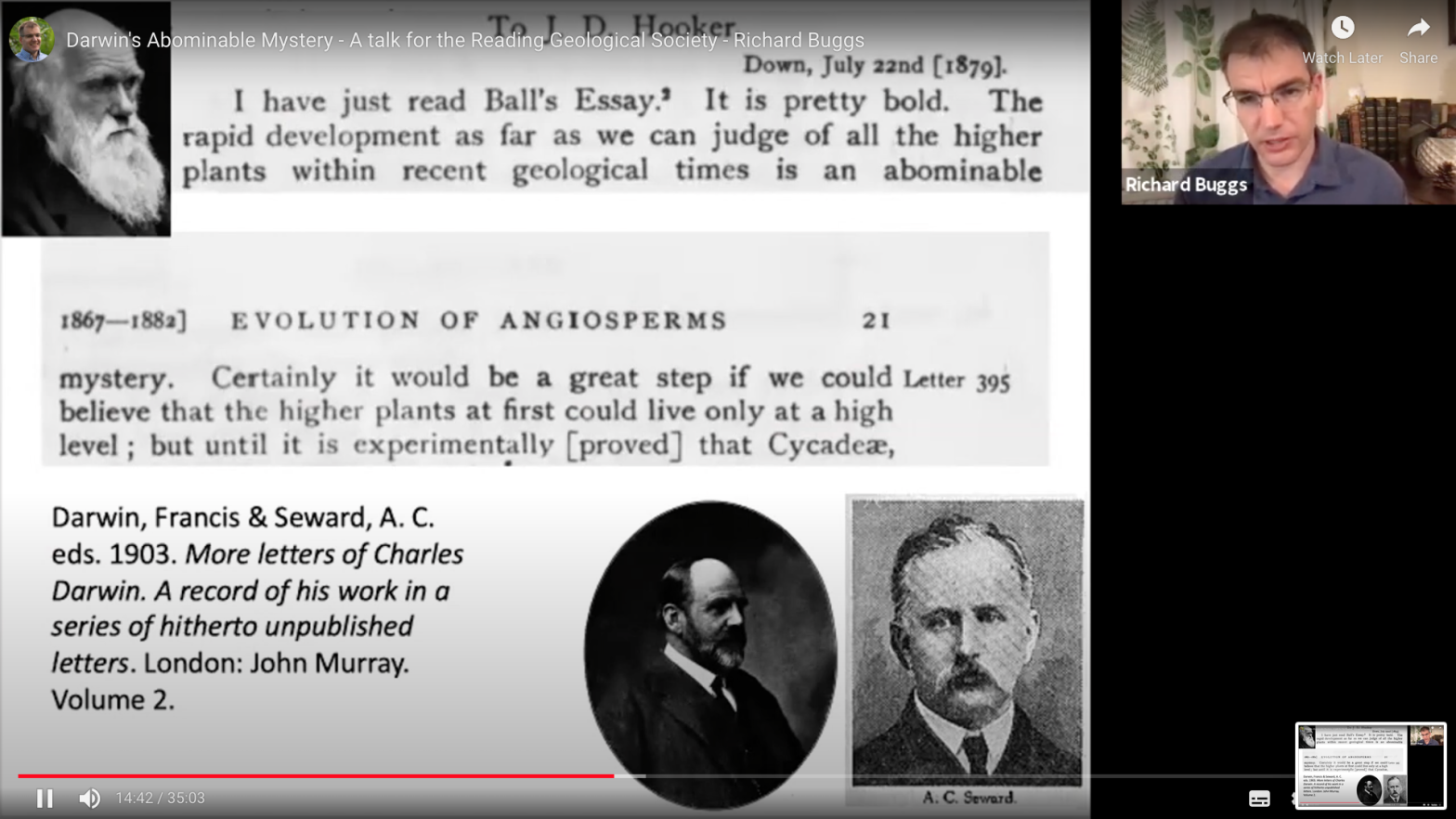
    Last evening I spoke for the Reading Geological Society on Darwin’s “abominable mystery”: the origin of flowering plants. My previous talks and publications (here and here) on this topic have focused mainly on the nineteenth century. In this new talk, I outlined twentieth century efforts to solve the mystery, which is something I continue to research.

    Here is the talk:

  • Video: Adam, Eve and human genetic diversity

    Video: Adam, Eve and human genetic diversity

    This video summarises my understanding of the current genetic evidence on whether or not humans could have passed through a bottleneck of a single couple at some point in our history.

    It is a talk I gave in May 2020 for a group of scientists from across Europe who identify as Christians. This audience came from a range of different disciplines, so I tried to present at a level understandable to any educated layperson.

    Everything I say here is preliminary and tentative. I welcome feedback and comments on this talk – especially from experts on human population genomics – especially if I say anything that is wrong. My box diagrams are of course simplifications, but I hope they convey the major concepts with clarity.

    Since I gave this talk, a major paper has been published in Nature presenting high coverage genome sequences for populations across Africa. The key analyses mentioned in my video based on the 1000 genomes project need to be re-done on this new, much better dataset. I won’t have time to do that any time soon, but if someone else did, I would be delighted.

    Christian viewers should not misunderstood me to be taking or recommending any particular scientific or exegetical position on a harmonisation between current science and the Bible. This talk has a much narrower focus than that. Much research has still to be done.

    If you are interested in following the links I mention in the video, my slides can be downloaded as a PDF here.

  • Video: More than evolution

    Video: More than evolution

    Here is a 20 minute lockdown video I published on YouTube a few days ago. In it, I make one major point: it is as hard to be an atheist today as it was 2400 years ago. In fact, a little harder.

    I have seen a few responses to this video by atheists since I put it up, but so far, none of these have addressed the major point I am making. I hope someone will soon.

    The material in this video is similar to a blog I posted a year ago: “Did Darwin make atheism credible“. If you prefer text to video, please do take a look there.

  • Why phylogenetics is difficult

    Why phylogenetics is difficult

    Here is a short video I made for one of my MSc classes, explaining why building phylogenetic trees is not easy.

    For examples of this phenomenon in my own research see here and here.

  • What was Darwin thinking? The origin of his ‘abominable mystery’

    What was Darwin thinking? The origin of his ‘abominable mystery’

    Happy Darwin Day 2021! This blog is about Darwin’s thought in the final years of his life, written for the Nature Ecology and Evolution community and re-published here.

    Back in 2012, The Natural History Museum of Milan invited me to give a talk for their Darwin Day symposium. Predictably for a botanist, I took the topic of Darwin’s “abominable mystery”. In 1879 Darwin famously wrote that “The rapid development as far as we can judge of all the higher plants within recent geological times is an abominable mystery.”

    That invitation got me started on nine years’ of research on the historical background of Darwin’s famous epithet for the plant fossil record. In 2017 I published some preliminary findings in Nature Ecology and Evolution. I published more detailed just a few days ago in The American Journal of Botany, with a paper titled: “The origin of Darwin’s abominable mystery“.

    This new paper majors on Darwin’s understanding of plant systematics and paleobotany in the late 1870s. I presented new evidence that for Darwin the ‘abominable mystery’ was about the sudden appearance of dicotyledonous fossils in the Cretaceous. This is different to today’s understanding that the abominable mystery applies to all angiosperms.

    This work caught the attention of the BBC science correspondent Helen Briggs, who published a thought-provoking article that was translated into Portuguese, Spanish, Indonesian, Chinese, and Italian. The Times of London also picked up on the story.

    Strangely enough, the issue of dicotyledons versus angiosperms was not the one that captured public attention.

    Darwin’s forgotten opponent

    It was a forgotten opponent of Darwin who gained the limelight. I stumbled upon him in the library of Kew Gardens, first as a citation in an 1888 textbook of paleobotany, and again soon after when a librarian emerged from the basement bearing a fragile pamphlet, printed in 1877: “Fossil Plants and their Testimony in Reference to the Doctrine of Evolution”.

    The pamphlet was a reprint of two scientific lectures. One delivered in 1876 made a detailed case that the fossil record of plants does not fit with Darwinian evolution, and instead could be explained by divine intervention. Especially the sudden appearance of the dicots in the Cretaceous. The author was William Carruthers.

    Could William Carruthers have contributed to making the plant fossil record an abomination to Darwin in 1879? The timing of his lecture seemed to make it likely, but could I make a direct link?

    I could not see his lecture mentioned anywhere in Darwin’s writings. But I pieced together three pieces of evidence that Darwin had been aware of it.

    Firstly, Carruthers’ 1876 lecture was reported at length in The Times immediately after he gave it, and Darwin was in the habit of reading The Times after lunch everyday. Darwin would hardly have missed a long article with the headline “Plant Evolution”.

    Secondly, among Darwin’s cuttings I found a copy of Carruthers’ lecture published in the Gardener’s Chronicle, one of Darwin’s favourite magazines.

    Thirdly, again among Darwin’s cuttings, I found a response to Carruthers’ lecture published by Nature in 1877.

    Together, these make a strong case that Darwin was aware of Carruthers’ view, and the wide publicity it gained.

    Uncomfortably for Darwin, William Carruthers was more qualified to speak about the plant fossil record than he was. Carruthers was the Keeper of Botany at the British Museum (Natural History) and had published many papers on paleobotany. Like Darwin, he was a Fellow of the Royal Society.

    To add piquancy, Carruthers was already out of favour with Darwin’s circle of friends. He had twice stymied their attempts to move herbarium collections from the British Museum to Kew. In 1874, Joseph Hooker described Carruthers to Darwin as an “Owenised Scotchman”, in reference to Darwin’s arch-enemy Richard Owen, a close colleague of Carruthers.

    This was not someone whom Darwin wanted to enter into a debate with, in an area where he had no ready answers.

    So Darwin’s term “abominable mystery” isn’t just about his perplexity with the plant fossil record. It also about his discomforting by his opponents.

    Do I blame journalists for passing over the technical detail of my paper to focus on this side of the story? I can’t say I do. I find it pretty interesting too.

  • Did Darwin make atheism credible?

    Did Darwin make atheism credible?

    Imagine that my wife and I walk into our living room one morning to find that our son’s toy box has fallen over, and pieces of BRIO train set track lie jumbled on the floor. But eight of the pieces are joined together in a perfect circle, lying on the floor, with a train on top of the tracks. My wife asks me: “Did you make that railway?” I say “No – it must have been you”. She says it wasn’t her. We look at each other for a moment, thinking and then we come to two different conclusions.

    My wife is worried and says: “Someone must have come into the flat last night. Railways don’t just spontaneously appear from a jumble of fallen pieces. We need to check my jewellery is still there.”

    I shake my head and say “This is evidence that there are billions more BRIO sets in the world than anyone has realised. I am going to call a stockbroker and buy some shares in BRIO PLC.”

    “Are you crazy?” my wife asks.

    “No,” I say. “What do you think the chances are that these pieces could have just fallen like that, and the train fallen on top of them? One in a billion? One in a trillion?”

    She says: “Maybe one in a trillion – it just couldn’t have happened by chance.”

    I reply: “Yes it could, if there are billions of BRIO train sets in the world that keep being tossed onto the floor. Ours just happens to be the lucky one that has spontaneously formed a perfect circle, with a train placed on top. I had never realised that BRIO train sets are so common. I don’t think anyone had. But here is evidence. There are billions of them.”

    My wife would think I was mad. Instead of the obvious explanation of an intelligent agent who has put the railway tracks together, I am invoking pure chance, justified by an outrageous speculation about billions of train sets.

    Arguments in ancient Greece

    This problem of explaining the origin of complex, purposeful structures by chance rather than by the action of a mind is a problem faced by atheists. In the natural world there are many structures that have multiple parts working together to make higher-order structures that have a purpose. These provide evidence of the work of an intelligent mind. The first philosophers to make arguments favourable to atheism – Leucippus, Democritus and Epicurus, living over 2000 years ago in Greece – were aware of this problem.

    The argument for an intelligent mind was made eloquently and persuasively by other Greek philosophers like Socrates and Plato. They drew an analogy between the natural world and human craftsmanship. Look at a statue. No one could deny that a statue is the work of an intelligent mind. How much more is the human body, of which the statue is just a simple representation, the work of an intelligent mind. There must be a supremely intelligent mind behind the natural world around us, and this is the mind of God.

    This analogy has been pervasive throughout human history. Hundreds of years later, Jesus Christ said: “Consider the lilies, how they grow: they neither toil nor spin, yet I tell you, even Solomon in all his glory was not arrayed like one of these.” Luke 12:27. He assumed it would be obvious to his listeners that flowering plants displayed more intelligent care than the royal robes of the King of Israel when his kingdom was at peak of cultural innovation. Jesus was making the same analogy between human craftsmanship and the natural world.

    All that early proto-atheists like Democritus and Epicurus could say in response to this argument for a mind was that complex, purposeful things in the natural world had just come about by chance. These were just lucky assemblages of atoms. To try to justify this, they said that the universe must be infinitely large and infinitely old, and that there are trillions of worlds within it. We just happen to be the lucky people who are on the stupendously lucky world on which things have happened to come together in such a way that complex life can exist.

    Not many people found this a persuasive argument. Even the staunch atheist Richard Dawkins concedes that arguments for atheism in the ancient world were not compelling. “I could not imagine being an atheist at any time before 1859 when Darwin’s Origin of Species was published” he wrote in The Blind Watchmaker.

    The case made by Democritus and Epicurus is as ridiculous as my inference of billions of BRIO train sets from the unexpected occurrence of a completed railway in my living room. Needing so much luck to explain the world, atheism did not take off.

    This left Socrates argument for design as one of the strongest arguments available to theists down through the centuries. The solar system, the world, the complex life forms on earth – none of these could have happened just by chance. We need the mind of God to explain their design and existence.

    As human technology has got more sophisticated over the ages, and we have discovered more about the natural world, analogies have constantly been drawn between the latest human technology and the natural world. The Roman Stoics compared Archimedes’ astronomical mechanism to the workings of the actual stars and planets. William Paley in 18th Century England compared a pocket watch to living things. Today we can compare the latest nanotechnology with the vastly more complex and efficient molecular machines found in every living cell. Or painstakingly written computer programmes with the information encoded in our DNA. The analogy between human craftsmanship and the natural world has cascaded down through the ages, gathering force with technological and scientific progress. It is a persuasive argument for the existence of God.

    Darwin according to Dawkins

    This argument was fatally undermined when Darwin published The Origin of Species according to atheists like Richard Dawkins. “Darwin made it possible to be an intellectually fulfilled atheist” he claims in The Blind Watchmaker. According to Dawkins, Darwinian natural selection can explain complex life forms without the need to invoke massive strokes of luck; without needing hugely improbably things to happen; without one-in-a-trillion events.

    How does it work? Let’s go back to our BRIO analogy. Imagine that instead of just being tipped on the floor once, my sons BRIO set kept being rejumbled every five minutes. Every five minutes there would be a fresh opportunity for bits of track to be joined together by chance. This is a bit like what happens in living things that reproduce. In every new generation there is a new opportunity for new variation.

    Now imagine that as well as this rejumbling of the BRIO every five minutes, there is also a rule in place that any bits of track that get joined together do not get rejumbled. They stay as they are. So as soon as two bits are together they stay together. They can wait until by chance a third bit gets added. Then the three bits can wait, and eventually a fourth bit by chance may get added. Eventually the full circle may form, and a train be dumped on top of it. The railway has evolved by a gradual process of cumulative selection.

    Step-by-step assembly of a trainset

    If you have a system set up like that, then the production of a functional train set does not seem so unlikely. It is a series of unlikely events, but that series does not seen half as unlikely as the spontaneous assembly of the full circle and train in one go. A lot of luck is still involved but not as much as before.

    This is the way that Dawkins tries to explain the origin of highly complex things by Darwinian evolution. It relies on small changes that are each selected for, because they provide greater fitness. Gradually they build up something more complicated. It all sounds plausible.

    In The Blind Watchmaker, Dawkins suggests that this process could generate something as complex as a human eye. He suggests that an organism could start off with a small light sensitive spot its skin, and gradually over millions of generations this could sink into a little cup in the skin, enabling better assessment of direction. Then it could be enclosed enough to be a pinhole camera. Then it could gain a lens, etcetera etcetera. Painted in broad brush strokes, it all sounds plausible.

    But the question we have to ask ourselves is: does this process eliminate enough luck from the origin of the natural world as we know it today for atheism to be credible?

    Chance in evolution

    In his book The God Delusion Dawkins writes about the Darwinian mechanism of evolution as if it only relies on chance in a very small way. He claims things like this: “Natural selection is a cumulative process which breaks the problem of improbability up into small pieces. Each of the small pieces is slightly improbable, but not prohibitively so” (p. 121, emphasis added). “Natural selection is not only a parsimonious, plausible and elegant solution; it is the only workable alternative to chance that has been suggested” (p. 120, emphasis added). He says that only “somebody who doesn’t understand the first thing about natural selection” would call it a “theory of chance”. He says it is the “opposite”.

    I should point out that Dawkins seems to be indulging in a little equivocation here. In one sense what he is saying is absolutely right: natural selection, when narrowly defined, is the opposite of chance. In biology research we often speak of evolution occurring via five forces: natural selection, drift, recombination, migration and mutation. In the context of these five forces, natural selection is the one that is non-random. So as a research biologist, if I superficially read Dawkins’ statements above, I can nod my head and agree.

    However, in the context of his book, Dawkins is using “natural selection” in a much wider, more colloquial sense, meaning the whole of the process of the evolutionary process. Used in that sense, it is quite wrong to say it is the “opposite” of chance. In fact, chance is an unavoidable component.

    At this point, I could go into a lot of detail about the process of Darwinian evolution, giving you lots of instances where it requires huge injections of luck.

    I could write about how evolutionary pathways can get trapped at local fitness peaks that are not global fitness peaks, and can only escape them by random drift. For example, if my BRIO train set had a circle made of eight pieces, which my toy train could happily rotate around, how could I get from that to a more complex train set? I would have to break the circle and insert a junction. I would have to go downhill from a local fitness peak in order to be able to climb a different fitness peak represented by a longer, more sophisticated railway.

    To get from the train set on the left to the one on the right, I have to break the circle. Without this backward step, the track cannot progress to greater complexity.

    I could write about evolutionary steps that need more than one concurrent mutation to work. To get two mutations in place at the same time that are both required before fitness is increased takes a big stroke of luck.

    I could write about new beneficial mutations that simply get unlucky and are eliminated from the population by random drift.

    I could write about how some new structures are very likely to need multiple part to come into place at the same time before they can function, and therefore require a lot of luck. For example, what if I had a system where I had to have a circular train set before the assemblage of pieces was selected for? It would take a lot of luck to build the train set. Given the complexity of the molecular machinery of life, it seems hard to imagine that such structures do not exist in biology. (Surprisingly, Dawkins is vehemently opposed to even looking for such things: “searching for particular examples of irreducible complexity is a fundamentally unscientific way to proceed,” he writes in The God Delusion (p. 125). That makes him sound less like a scientist and more like someone views his beliefs as sacrosanct from testing.)

    In short, it is very well known to biologists working in the field (and, no doubt, to Dawkins himself) that chance is a very important element in the evolutionary process. But if you read The God Delusion as a non-biologist, you are likely to come away with the impression that it hardly involves any luck at all.

    Dawkins’ own invocation of luck

    But in reality, I don’t need to make those points. I can grant Dawkins everything he claims for the evolutionary process, and still show from his own admissions that he can’t get away from needing astronomical doses of pure luck to explain how we got here. Atheism has not got away from its problem of an implausible reliance on luck.

    Here is a page from Dawkins’ book The God Delusion:

    We really need Darwin’s powerful crane to account for the diversity of life on Earth and especially the powerful illusion of design. The origin of life, by contrast, lies outside the reach of that crane, because natural selection cannot proceed without it. Here the anthropic principle comes into its own. We can deal with the unique origin of life by postulating a very large number of planetary opportunities. Once that initial stroke of luck has been granted – and the anthropic principle most decisively grants it to us – natural selection takes over: and natural selection is emphatically not a matter of luck.

    Nevertheless, it may be that the origin of life is not the only major gap in the evolutionary story that is bridged by sheer luck, anthropically justified. For example, my colleague Mark Ridley…has suggested that the origin of the eukaryotic cell (our kind of cell with a nucleus and various other complicated features such as mitochondria, which are not present in bacteria) was an even more momentous, difficult and statistically improbable step than the origin of life. The origin of consciousness might be another major gap whose bridging was in the same order of improbability. One-off events like this might be explained by the anthropic principle, along the following lines. There are billions of planets that have developed life at the level of bacteria, but only a fraction of these lifeforms ever made it across the gap to something like the eukaryotic cell. And of these yet smaller fraction managed to cross the later Rubicon to consciousness. If both of these are one-off events, we are not dealing with a ubiquitous and all pervasive process, as we are with ordinary run-of-the-mill biological adaptation. The anthropic principle states that since we are alive, eukaryotic and conscious, our planet has to be one of the intensely rare planets that has bridged all three gaps.

    Natural selection works because it is a cumulative one-way street to improvement. It needs some luck to get it started, and the ‘billions of planets’ anthropic principle grants it that luck. Maybe a few later gaps in the evolutionary story also need major infusions of luck, with anthropic justification.

    Richard Dawkins (2006) The God Delusion page 140 (emphasis added)

    Here, despite his repeated claim that “natural selection is emphatically not a matter of luck”, Dawkins is still reduced to invoking huge amounts of luck to explain how we got here. He is making the same argument as Democritus and Epicurus: he needs so much luck that he has to invoke billions of worlds. He has to posit billions of planets that are potentially habitable by conscious life forms.

    Dawkins’ argument is weaker than that of Democritus and Epicurus. They claimed that the universe is infinite in terms of both space and time. But Dawkins knows that the universe has a beginning, so he does not have infinite time to work with. He also knows that it is not infinite in size. This dramatically reduces the probabilistic resources available to him within this universe compared to what Democritus and Epicurus thought they had.

    If you read further in The God Delusion, Dawkins also finds himself not just having to invoke billions of habitable planets, but also billions of universes too, to explain why the physical constants of our universe are so fine-tuned for life. Though there is no empirical evidence for multiple universes, it is all Dawkins has to fall back on to give himself the huge amount of luck that he needs to explain reality.

    Conclusion

    Even if we grant Darwinian evolution all the power for eliminating luck that Dawkins claims for it, atheism is still a huge leap of faith in blind chance. Despite writing: “I could not imagine being an atheist at any time before 1859 when Darwin’s Origin of Species was published”, Dawkins finds himself falling back on arguments made by Democritus and Epicurus in ancient Greece. Dawkins’ ultimate reliance on these ancient invocations of luck undermines his case that Darwin made atheism credible.

    Like the ancients, we are still left with a choice between huge amounts of luck, or a divine mind behind the universe and life.

  • Adam and Eve our ghostly ancestors?

    Adam and Eve our ghostly ancestors?

    That a single couple could be the ancestors of all living humans is widely seen as an area of conflict between genetics and the Abrahamic religions. Though little detailed attention has been paid to this idea in the scientific literature (see ‘Adam and Eve: a tested hypothesis?’), current models of the history of genomic variation in African populations tend to forbid a bottleneck of two in the human lineage within the last five hundred thousand years (see ‘Adam and Eve: lessons learned’). Thus, belief in a literal pair of ancestors for all humans would entail an older date for Adam and Eve than believers had expected, or a revised understanding of human molecular evolution.

    In a recent book, The Genealogical Adam and Eve, S. Joshua Swamidass, an Associate Professor at Washington University in St Louis, Missouri, seeks to resolve the dilemma faced by believers. He makes a major contribution to the debate, taking both sides seriously. Swamidass is a Christian himself, and a well-established scientist in chemical bioinformatics and drug metabolism. He has clearly read widely and deeply in evolutionary genetics. He outlines his ideas with caution and many references to the literature. He deserves a hearing by anyone who is interested in a better relationship between science and religion.

    Joshua Swamidass
    Dr S. Joshua Swamidass

    Swamidass suggests that Adam and Eve were a real pair who are present in the genealogical ancestry – but not necessarily the genetic ancestry – of all present-day humans. He draws on simulations published in Nature in 2004 by Douglas Rohde, Steve Olson and Joseph Chang showing that just a few thousand years ago many individuals must have existed who are genealogical ancestors of all present-day humans. Swamidass makes the simple suggestion that one pair of the shared ancestors of all living humans was “Adam and Eve”.

    He also points out that not all of our ancestors contribute to our genomes. Those that do not are known as “ghost” ancestors. Thus, Swamidass’s “Adam and Eve” will have contributed nothing to the genomes of some, many, or perhaps even all, living humans. “Adam and Eve” are entirely untraceable using genetic information. Thus, believers can say all humans are descended from Adam and Eve, and no genetic evidence can falsify or confirm that belief. 

    From a purely genetical perspective, it seems hard to contradict this thesis. The findings of Rohde et al (2004) have been scrutinized and broadly confirmed by several papers that Swamidass cites and explains in his book. The fact that not all of our ancestors contribute to our genomes a simple corollary of Mendelian genetics. Swamidass notes that this view of Adam and Eve is (superficially at least) compatible with a diverse range of possible beliefs about when they lived, where they lived, and whether or not divine intervention was involved in their origin.

    Swamidass argues that if his hypothesis is true, then there is “no evidence for or against Adam and Eve, ancestors of us all” (p. 81). Thus, he has an essentially unfalsifiable hypothesis regarding Adam and Eve. By doing this, he reaches something close to Stephen Jay Gould’s non-overlapping magisteria (NOMA) between science and religion, in an area where they have often been seen as making competing claims about reality. He hopes that this may be a way of making peace.

    A more detailed scenario

    Having established this basic claim that “Adam and Eve” are an undetectable pair hidden among our many shared ancestors, Swamidass cautiously builds up a more detailed scenario for our history. He seeks to maximise its appeal to as many believers as possible by bringing the narrative as close as possible to a literal reading of the Bible, without increasing its exposure to scientific falsification. 

    This leads Swamidass to posit a surprising scenario in which Adam and Eve were created de novo a few thousand years ago, essentially as carbon copies of pre-existing humans who had evolved from apes. Their offspring then freely mingled with the existing human population, and “like a drop of water in the ocean, Adam and Eve’s genome quickly disappeared” (p. 81). Confusingly, Swamidass describes his created Adam and Eve as “monophyletic” with evolved human beings, but by this he means “of the same biological type” (p. 85), rather than the more usual definition of “sharing common ancestry”. 

    Given that he invokes a miracle, one might assume that Swamidass includes within it some kind of biological, mental or spiritual (“ghostly”, to use an archaism) advance unique to Adam and Eve. He explicitly eschews such novelties. This shields his scenario from the possibility of scientific falsification (though not, of course, from philosophical arguments that miracles are anti-science), but makes the proposed divine intervention rather pointless and arbitrary.

    To avoid the possibility of testing, Swamidass seeks to have no objective criteria external to the Bible that define Adam and Eve as distinct from other humans. He rejects terms like “philosophical humans” to describe them and instead prefers the term “textual humans” – in other words, what the Bible means by humans is what the Bible means by humans. Thus, he allows believers to define humans in a manner that is entirely decoupled from science, and concomitantly, irrelevant to science.

    There are some features of this proposal that are attractive. It seemingly diffuses an area of tension between science and faith by allowing belief in a literal Adam and Eve who lived a few thousand years ago, seemingly without any conflict with current science. There are no doubt many theological objections to Swamidass’s ideas (see, for example, here). In terms of how his ideas interact with science, I see two areas of weakness. 

    1) Dating uncertainty

    The appeal of Swamidass’s proposal rests on our beliefs about the certainty and age of three dates: (A) the most recent date at which all humans could have passed through a bottle-neck of two, giving a pair of universal genetic ancestors; (B) the most recent date at which all humans could share a pair of genealogical ancestors; (C) the date of Adam and Eve that seems to be implied by the Bible. 

    Figure 1: Diagrammatic Timeline
    Diagrammatic Timeline: Joshua Swamidass’s proposal is at its strongest if there cannot have been a genetic bottleneck of two in the human lineage within the last few hundred thousand years (A), and if the most recent genealogical ancestors of all living humans (B) existed at a time close to dates for Adam and Eve inferred from the Bible (C). All of these dates are open to question.

    Swamidass’s proposal is most compelling if we believe with a high degree of certainty that (B) and (C) are the same and much smaller than (A). Swamidass argues that this is the case. But what if (C) was in fact uncertain, as many Christians argue? Or (B) was much higher than suggested by Rhode et al (2004)? Or (A) turned out to be smaller than we had imagined due to the presence of previously unaccounted for factors shaping the molecular evolution of African populations (such as a ghost lineage, or complex past metapopulation structure, for example)? In these cases, his scenario would be less attractive to believers.

    Because the possibility of a real Adam and Eve is not a topic that the majority of geneticists are interested in, the literature on (A) and (B) is extremely limited, and the subject has not been fully explored. There may well be plausible scenarios in which (B) could become too large for an easy fit with (C) or by which (A) and (B) become close enough to one another for Swamidass’s scenario to lose much of its appeal. 

    For example, a more recent model than Rhode et al (2004) for estimating (B) was published by Kelleher, Etheridge, Véber and Barton (2016). This gives a much older date for the common genealogical ancestors of humans. Swamidass dismisses this study as (p. 59) “less relevant” because it “unrealistically” restricts migration to only a few kilometres. However, there is clearly room for debate, and future studies that include genetic data in order better to parameterise migration in genealogical models may give estimates that force Swamidass into a scenario that works less well than his current one. 

    2) The ghost in the machine

    Another area of potential difficulty for Swamidass’ scenario is the origin of human consciousness: the “ghost in the machine”. Swamidass’ main focus is on reconciling Biblical and scientific dates for Adam and Eve. But for many believers, this issue may be peripheral compared to the conviction that the story of Adam and Eve is related in some sense (regardless of whether it is historical or mythological) to the origin of the soul. Previous attempts to reconcile Adam and Eve with evolution have tended to avoid a physical miracle but posit a non-physical divine intervention conferring human consciousness. 

    It is not unreasonable for someone with a prior belief in God to think that the origin of human consciousness might involve more than just physical processes. The difficulties of explaining consciousness in terms of material processes and Darwinian evolution have been recently explored by the atheist philosopher Thomas Nagel in his book Mind and Cosmos. Christian philosopher Richard Swinburne argues something similar in his book The Evolution of the Soul. In chapter 4 of his book The God Delusion Richard Dawkins suggests that the origin of consciousness is “even more momentous, difficult and statistically improbable step than the origin of life”. It is not surprising therefore that theists would tend to see fingerprints of the divine in the origin of consciousness, and especially human consciousness. That Christian theists should associate the latter with Adam and Eve is understandable, as St Paul writes: “The first man Adam became a living soul” (1 Corinthians 15:45).

    Superficially it might appear that such a spiritual intervention could easily be combined with Swamidass’s view, but as he works through his detailed scenario in the latter half of his book it becomes clear that such a combination would be highly problematic. If his genealogical Adam and Eve were the first to have human consciousness they would be objectively differentiated from evolved humans. This could open up his scenario to scientific testing and could also imply that some members of Homo sapiens were sub-human; both of these possibilities he wishes to avoid. Therefore, he concludes that, long before Adam and Eve, people had “minds and souls” and “science legitimately tells us the story of how they arose” (page 175). Believers may find this decoupling of Adam and Eve from the origin of the soul more questionable than an ancient date for an Adam and Eve who could be universal genetic ancestors of all humans with “minds and souls”. 

    Concluding thoughts

    Given the surprisingly recent date at which shared genealogical ancestors arise in populations, it was well worth exploring how this might fit with the age-old belief in Adam and Eve. Joshua Swamidass does this in a highly detailed and truly inter-disciplinary manner. He shows respect for all sides, sincerely wanting to find a way forward that can defuse an area of conflict. It is to be hoped that this book will motivate the more sophisticated modelling of the human population history. It may also make believers ask questions about their hierarchy of beliefs about Adam and Eve. Is the most important thing about them the time in which they existed, or something that made them objectively unique? Are they genetic ghosts, or ghostly ancestors? The book has less to say to the atheist or agnostic reader, except perhaps to convince them that Christian views of Adam and Eve could be irrelevant to objective reality, and to persuade them that there are reputable scientists who take both science and religion seriously. No doubt Joshua Swamidass will be on this year’s shortlist for the Templeton Prize.

    This blog was first posted at Nature Ecology & Evolution Community on 4 March 2020

    .

  • Unselfish gardeners? Christianity and the environment

    Unselfish gardeners? Christianity and the environment

    Human degradation of the natural environment is a great tragedy of our time. One of its major drivers is selfishness leading to over-consumption and waste. Despite growing concern about the environment, the majority of us struggle to forgo convenience and consumption for the long-term good of the planet.

    We find it easy to signal environmental virtue by giving up disposable coffee cups, but harder to give up holiday air-travel. It is easy to ask a government to tax petrol, but harder to resolve an ensuing “yellow vest” protest from the people hit hardest.

    Conflagration of plastic fruit crates at a packing centre in south-east England

    We face the tragedy of the commons. Why should individuals sacrifice ease and indulgence to make a tiny contribution towards averting a future common catastrophe? A catastrophe that may not occur until our own life with all its luxuries or inconveniences is gone.

    We all know we should do our bit, but we easily to descend into hypocrisy. We burnish our green credentials with a hybrid car but choose to live an unnecessarily long commute from work. We eschew palm oil but upgrade our phone each year.

    But if I see through this selfishness and hypocrisy, and genuinely try to do my bit, where do I stop? Do I give up all travel, all new possessions, all energy consumption? Do I cut all my carbon dioxide emissions? Even my own exhaling breath?

    Pushed to a logical extreme, the most environmentally-friendly thing I can do is die. To be fully pro-environment, I become anti-human. How can I get a healthy balance? Or do I need to live with a perpetual guilt for my own existence?

    We need an approach to environmentalism that provides motivation to individuals to do their bit despite the possibility that they may never themselves see the benefits of it. We need an environmentalism that cuts through selfishness and hypocrisy. We need a coherent way of being pro-environment but not ultimately anti-human.

    The Christian Bible might seem a strange place to look for this, given that it was completed long before humans had the technical capacity to cause rapid and wide-scale damage to the natural world. But I will argue that several aspects of its teaching can help resolve the moral and motivational conundrums of environmentalism. In essence, it tells us to live the lives of unselfish gardeners.

    According to the opening chapters of the Bible, the attitude that God intends humans to have towards the natural world is that of gardeners. They are to tend the world as a gardener tends a garden. They are doing God’s will if they cultivate their natural environment to provide for their material needs, and at the same time nourish its beauty and diversity.

    Reforestation in Madagascar

    This care for the natural environment is echoed many times throughout the Old Testament. God told Israelite farmers to leave all their land fallow one year in seven. Every 50 years all land had to be returned to its original owner or his children, breaking up agricultural conglomerates or preventing their development. In times of warfare, fruit trees could not be cut down: “Are the trees in the field human, that they should be besieged by you?” (Deuteronomy 20:19).

    If we love God – which Jesus said is the first and greatest commandment – the we will want to live up to the gardening responsibility he has given us and care for the natural world.

    Furthermore, Jesus calls his followers to live unselfish lives. They must love their neighbours. They must live lives that are not self-indulgent or overly-luxurious. Jesus teaches us to be content with the basic necessities of life. “Do not lay up treasures on earth…do not be anxious about your life, what you will eat or what you will drink, nor about your body, what you will put on. Is not life more than food, and the body more than clothing? But seek first the kingdom of God and his righteousness, and all these things will be added to you” (Matthew 6:19-33).

    The primary motivation Jesus gives for unselfish lives is our relationship with God and our fellow humans. But such lives inevitably benefit the natural environment: we will not spend inordinate quantities of natural resources on luxuries and conveniences that are far beyond the basic necessities of life.

    Jesus’ teaching should also make Christians highly sensitive to hypocrisy. “Beware of practicing your righteousness before other people in order to be seen by them, for then you will have no reward from your Father who is in heaven,” he warns (Matthew 6:1). “Woe to you…hypocrites! For you tithe mint and dill and cumin, and have neglected…justice and mercy and faithfulness. These you ought to have done, without neglecting the others.” (Matthew 23:23). That should give me pause for thought if my only efforts towards environmental-friendliness are a Tesla and a reusable coffee cup.

    Jesus is teaching us that if we get our relationship with God right, then everything else will follow. We can cut thought the tension of environment-centeredness versus human-centeredness by being God-centred. This allows us to have unselfish attitudes that will benefit everyone and everything round us.

    The Bible presents Jesus as the supreme example of a self-sacrificial life in coming into this selfish world to bring salvation through this death. His death not only accomplished redemption for humans who trust him but also ultimately for their environment. The apostle Paul teaches that Jesus will return a second time and “creation itself will be liberated from its bondage to decay” (Romans 8:21). This should give Christians a deep optimism about the ultimate worth and future of the natural environment.

    I struggle to see why Christians could ever justify being unconcerned about the natural environment, or be satisfied with a self-indulgent or hypocritical lifestyle. In fact, the teaching of the Bible, and of Jesus himself, could help all of us, whether we identify as Christians or not, to live more environmentally-friendly lives.

  • Lost elms of Kent

    Lost elms of Kent

    Mature elm trees in the English landscape are something I and many other have never seen. Dutch Elm Disease killed them all in the 1960s. Only the older generation can remember what we have lost. Browsing through some local photos from the 1930s this weekend, my eyes were opened to the size and grace of the elms that once existed. Here are some of those photos, from Capel, Kent. Beneath each one I show a picture of what the scenes look like today.

    (more…)
  • How to lead a journal club

    How to lead a journal club

    Getting together to discuss a published paper is a classic way of keeping on top of the literature and training students how to read it.

    During my postgraduate studies I went to a journal club every week organised by my PhD supervisor. It was here that I learned how to read a scientific paper, and gained confidence in critiquing published studies. Now I run a journal club for my MSc students, and sometimes (but not often enough!) for my PhD students. Here are some tips I give my students before they lead a journal club meeting.

    (more…)
  • How similar are human and chimpanzee genomes?

    How similar are human and chimpanzee genomes?

    I recently participated in a discussion on the Biologos forum on the degree of similarity between the human and chimpanzee genomes. I was asked for my current view on this issue by Dennis Venema, who had found a old quote online from a newspaper article that I had written in 2008 on this issue. In 2008, in a couple of newspaper articles, I did some simple calculations based on the 2005 Chimpanzee genome paper. On the basis of these, I had come to the surprising conclusion that these data suggested that the human and chimpanzee genomes in their entirety could be only 70% identical. Dennis Venema asked me if this was still my view. You can read the whole discussion here. It is rather long, with lots of tangential contributions. If you want a quick summary of my perspective,  here is my final closing statement (which I originally posted here):

    “How similar are the human and chimpanzee genomes?” is a relatively straightforward scientific question. We are hindered by the still somewhat incomplete nature of both the human and the chimpanzee reference genome assemblies, but we can make this clear in our assessments and allow for the uncertainties that it raises.

    The best way to assess the similarity of two genomes is to take complete genome assemblies of both species, that have been assembled independently, and align them together. The alignment process involves searching the contents of the two genomes against each other.

    (more…)
  • Adam and Eve: lessons learned

    Adam and Eve: lessons learned

    This blog was first posted at Nature Ecology & Evolution Community on 14 April 2018

    Preliminary conclusions about the possibility of a short, sharp human bottleneck

    A few months ago I asked this community if modern genome science had tested an “Adam and Eve” hypothesis that the human lineage has passed through short, sharp bottleneck of two at some point in its history. While this question may sound bizarre to some, it is one that is often asked by those with a background in Abrahamic faiths. My post has therefore been taken up and discussed extensively on the Skeptical Zone and Biologos Forum over the past few months, as well as by various blogs.

    The claim that genomic methods have been used to test and reject an “Adam and Eve” hypothesis was central to the recent book Adam and the Genome. My post, which critiqued the arguments made in that book, has received a broad level of explicit or tacit agreement in subsequent online discussions. More adequate ways of testing the hypothesis have been suggested, and preliminary results have been obtained.

    Here I will share some of the lessons I have learned from these discussions and from further reading. These are somewhat tentative, and not all are based on published peer reviewed literature. In a short blog I cannot do not do full justice to all the contributions that have been made by various scientists within the online fora, so as far as possible I will try to provide direct links to the contributions of others.

    Here are the lessons I have learned so far:

    (more…)
  • Coalescence at bottlenecks

    Coalescence at bottlenecks

    This is Part 1 of my response to Dr Dennis Venema’s second Biologos Blog “Adam, Eve and Population Genetics: A Reply to Dr. Richard Buggs (Part 2)”. Dr Venema was responding to my blog at Nature Ecology and Evolution Community about his book Adam and the Genome. Since Dr Venema’s Part 1 blog responding to me, a vigorous debate has been ongoing on the Biologos Forum here. This debate is now beginning to come to a conclusion, so I have a bit of time to respond to the Part 2 blog by Dennis, which branched out from the Forum debate. Here is Part 1 of my response.

    (more…)

  • Babbage Podcast (The Economist) interview on tree health

    https://soundcloud.com/theeconomist/babbage-trees-take-a-bough

    Just before Christmas, I was interviewed by Howie Shannon for The Economist’s “Babbage” podcast. Here it is!

  • Response to Dennis Venema’s Blog “Adam, Eve and Population Genetics: A Reply to Dr. Richard Buggs (Part 1)”

    This is my response to Dennis Venema’s Biologos blog that he posted after I published my email and blog at Nature Ecology and Evolution Community about his book Adam and the Genome. This text is also placed as a comment under Dr Venema’s blog post on the Biologos blog page.

    Dear Dennis,

    I am glad that we are now establishing a dialogue about the scientific credibility of a bottleneck of two at some point in the history of the human lineage. I am hoping that during the course of this discussion we will be able to examine in detail the claims that you make in chapter three of Adam and the Genome, and that you will respond to all the critiques and questions that I have raised in my email to you and my blog at Nature Ecology and Evolution Community.

    (more…)

  • Responding to Felsenstein, Schaffner and Harshman at The Skeptical Zone

    Here is the text of a comment I posted at The Skeptical Zone in response to comments by Joe Felsenstein, Steve Schaffner and John Harshman on my Nature Ecology and Evolution blog on human bottlenecks:

    Thank you all for interacting with my Nature Ecology and Evolution Community blog, and thanks to Vincent Torley for posting here. Vincent kindly sent me a personal email pointing out this thread to me and asking me to specifically interact with comments made by Steve Schaffner and Joe Felsenstein. I will also comment on John Harshman’s comments as he is making the strongest case against a bottleneck of two, which was not mentioned explicitly by Dennis Venema in his book chapter. (more…)

  • Marcus Wallenberg Prize 2017

    Last week in Stockholm the forest geneticist Prof. Ron Sederoff was awarded the Marcus Wallenberg Prize. Informally known as the “Nobel Prize for Forestry”, this two million Swedish Krona award is presented by the King of Sweden each year. It is the first time for a decade that the prize has gone to a biologist.

    In the 1980s, Ron Sederoff realised that molecular genetics had the potential to transform research on trees. (more…)

  • Adam and Eve: a tested hypothesis?

    Does genomic evidence make it scientifically impossible that the human lineage could have ever passed through a population bottleneck of just two individuals? This is a question I am asked semi-frequently by religious friends. With my current understanding of the genetic evidence, I can’t state categorically that it’s impossible. In this view, I find I differ from a recent book chapter on the topic. I’m writing this blog to run my thoughts past other biologists, and check I am not missing something. (more…)

  • Email to Dennis Venema about human population bottlenecks

    A few months ago, I was reading a new book by Dennis Venema and Scot McKnight entitled Adam and the Genome. I was surprised to find a claim within the book that the past effective population size of humans has definitely never dropped below 10,000 individuals and that this is a fact of comparable scientific certainty to heliocentrism. I emailed Dennis Venema, the biologist author of the book, to query this. Unfortunately, he has not yet responded. I therefore remain unconvinced that it is a scientific impossibility for human beings to have all descended from a single couple. If I am wrong, though, I would like to know. I therefore post my email here, in hopes of garnering responses to my objections. (more…)

  • “Abundant bioactivity” of random DNA sequences?

    This blog was written for the Nature Ecology and Evolution Community where it is posted here.

    Probing the claims of a recent study

    Readers of this blog will be aware of the recent Nature Ecology and Evolution paper entitled “Random sequences are an abundant source of bioactive RNAs or peptides”. Rafik Neme, the first author, posted an engaging Behind the Paper blog here.

    On a quick look, I thought the study might be the beginnings of the solution to the mystery of orphan genes. (I posted about orphan genes here a few months ago.) The paper appears to demonstrate that an unexpectedly high percentage of random 150 base-pair DNA sequences are functional when expressed in E. coli. If true, this would suggest that de novo gene evolution could occur easily from junk DNA. (more…)

  • Darwin’s abominable mystery

    One of the hidden gems of Royal Botanic Gardens Kew is its library. I spent several happy hours there researching a recent letter to Nature Ecology and Evolution, published in June under the title “The deepening of Darwin’s abominable mystery“.

    The brightest moment came when a helpful librarian found me an 1838 reprint of a lecture by palaeobotanist Adolphe Brongniart: a lecture that I had not even known existed. Not only did this turn out to be the lecture that had provided Darwin with key information about the plant fossil record as he wrote his notebooks on the transmutation of species, but it was reprint sent by the author to J. S. Henslow, Darwin’s botany professor at Cambridge. It probably came to Kew via his son-in-law Joseph Hooker, Director of Kew, to whom Darwin famously wrote in 1879 that “the rapid development as far as we can judge of all the higher plants within recent geological times is an abominable mystery” .

    At moments like this, history is tangible. And it is sometimes at such moments that we have to reassess our anachronistic understandings of past science. This is the message of my Nature Ecology and Evolution letter. In it I argue that Darwin’s “abominable mystery” has been misunderstood ever since it came into the public sphere in 1903. This is because it has been assumed that by “higher plants,” Darwin meant “angiosperms”; that is, all flowering plants.

    The 1903 edition of Darwin’s letter

    Between 1879 and 1903 Darwin’s letter to Hooker about the “abominable mystery” lay unpublished. When it was published in 1903, the editors, A. C. Seward and Francis Darwin left the readers in little doubt that Darwin meant “angiosperms” when he said “higher plants”. This can be seen in their page-header shown below (N.B. the word “abominable is at the end of the previous page).

    Later in the book, the editors described their own view of the plant fossil record in a footnote saying: “No satisfactory evidence has been brought forward of the occurrence of fossil Angiosperms in pre-Cretaceous rocks. The origin of the Monocotyledons and Dicotyledons [i.e. the two major groups of Angiosperms as they knew them] remains one of the most difficult and attractive problems of Palaeobotany.” (p.239).

    The understanding of the fossil record that A. C. Seward and Francis Darwin had in 1903 is still the understanding held by the majority of palaeobotanists today. In fact, Nature Plants recently published a through debunking of all claimed pre-Cretaceous angiosperms by some of the world’s most authoritative experts in the palaeo-flora of the lower Cretaceous.

    So from 1903 to today, everyone has thought that Darwin’s “abominable mystery” is about the origin of all angiosperms, suddenly and in great diversity in the Cretaceous, with no obvious ancestral lineage.

    It has therefore been assumed that any reliable pre-Cretaceous angiosperm fossil, or any clear progenitor lineage, or the identification of a sister lineage to the angiosperms, would be a major step towards the solution of the abominable mystery.

    The problem is – as I discovered from Henslow’s copy of Brongniart and several other nineteenth century sources – Darwin’s understanding of the plant fossil record was rather different. Darwin thought that there were pre-Cretaceous angiosperms, and that there was a clear progenitor lineage for the Cretaceous diversity of “higher plants”.

    Discovering Darwin’s view

    This surprising discovery first began to dawn on me when I read an 1879 lecture by John Ball, upon which Darwin was commenting in his “abominable mystery” letter to Hooker. Ball’s essay is a bit obscure to the modern reader as he refers to two groupings of angiosperms: “exogens” and “endogens”. These are obsolete terms, from de Candolle, for monocotyledons and dicotyledons (to make it even harder on the modern reader, the term dicotyledon is also obsolete, although most botanists at least still understand the term).

    John Ball (1879) describes the plant fossil record as showing that exogens (monocotyledons) have a long fossil record, and the endogens (dicotyledons) suddenly evolved from them and diversified rapidly in the Cretaceous. In the context of this lecture, therefore, Darwin seemed to be referring to the sudden appearance of diverse dicotyledons – rather than all angiosperms – in the fossil record as the “abominable mystery”.

    I wanted to be sure that this was the case, by both making sure that this was actually Darwin’s own view, and tracing back the original sources of this view of the plant fossil record.

    This proved easier than expected, because the Darwin Correspondence Project have in the last two years published letters between Darwin and two palaeobotanists Oswald Heer (in 1875), and Gaston de Saporta (in 1876). In these letters, it is clear that Darwin believed that it was dicotyledons that appeared suddenly in the Cretaceous, not angiosperms as a whole. This was partly on the basis of original findings described to him by Oswald Heer, who wrote to Darwin: “The interval from the Devonian to the Cretaceous is immensely long, and, as far as we know until now, the vegetable kingdom then consisted only of cryptograms, confiers & cycads and a few monocots. In the upper Cretaceous , however, the flora suddenly underwent a great transformation and…there appear for the first time the (angiosperm.) Dicotyledonae”.

    As I was browsing through volumes of Darwin’s Correspondence in the Kew library, I noticed near them a plump hardback Concordance to Darwin’s notebooks. On a whim, I looked up the word “angiosperm”, and found nothing at all. The I looked up the term “dicotyledonous” and found a line written by Darwin in the late 1830s that seemed to be about the fossil record.

    Did Kew have a copy of Darwin’s notebooks? Yes they did, published in the Bulletin of the British Museum in 1960. I found the reference, and to my intense interest read:

    “L’Institut 1837 p. 319 Brongniart – no dicotyledonous plants and few monocot in coal formation? …p. 320 Says coniferous structure intermediate between vascular or Crypogram (original Flora) and Dicotyledones, which nearly first appear (p. 321) at Tertiary epochs.”

    Here is a scan of the page in Darwin’s first notebook on the transmutation of species (reproduced with permission from J. van Wyhe ed., Darwin Online)

    What this meant is that in 1837 or 1838, decades before his correspondence with Oswald Heer and Gaston de Saporta, and his reading of John Ball’s essay, Darwin thought that monocotyledons had a much longer fossil record than dicotyledons.

    Now I wanted to find what Darwin had been reading. This appeared easy, as Gavin de Beer, the 1960 editor of Darwin’s notebooks, had provided a footnote referring to “A. Brongniart. “Végétaux fossiles”, L’Institut, Paris 5, 1837, 220, p. 318.”

    I requested this book from the Kew librarians, and looked up page 318. There was nothing relevant there about the monocot fossil record. I scoured the volume, and could not find what Darwin was referring to.

    Then I noticed that the librarian had also brought me another book, a much thinner volume, belonging to J. S. Henslow. It contained a reprint of a lecture given by Brongniart at L’Institut de Paris in 1837, with the catchy title: Considerations sur la nature des vegetaux qui ont couvert la surface de la terre aux diverses epoques de sa formation.

    I picked this up. It had fewer than 300 pages, so it seemed futile to look for Darwin’s references. But then on pages 19, 20 and 21 respectively I found the information that Darwin had noted as being on pages 319, 320, and 321 of the edition that he had been reading. It was this lecture by Brongniart, rather than his more famous magnum opus Végétaux fossiles, that Darwin was referring to in his notebooks.

    So from the 1830s through to the 1870s, Darwin was hearing from leading palaeobotanists that monocotyledonous angiosperms preceded dicotyledonous angiosperms in the fossil records. There was no doubt left in my mind that this was Darwin’s view.

    Darwin considered the “abominable mystery” to be the sudden appearance and diversification of dicotyledons in the Cretaceous, with monocotyledonous angiosperms present in the fossil record back to the carboniferous.

    Below is a diagram taken from an 1885 textbook “Sketch of Paleobotany” by Frank L. Ward, which depicts the plant fossil record as it was understood in Darwin’s time. I have highlighted in green the part that has not been widely believed since around 1900.

    What this means for today

    This means that if Darwin were here today, and we persuaded him that Brongniart, Heer and de Saporta had mistaken the identity of the pre-Cretaceous “monocot” fossils that they had found in pre-Cretaceous rocks, Darwin would consider the mystery to be a lot more abominable in 2017 than it had seemed to him in 1879. Far from being solved, his abominable mystery has got a lot deeper.

    Thus, many of the solutions we are seeking for the mystery today – such as pre-Cretaceous angiosperms – even if they were found, would simply restore the mystery to the depth that it appeared to have for Darwin. They wouldn’t solve it.

    We often think that the history of science is a tale of inexorable progress, where mysteries get smaller and smaller. Darwin’s abominable mystery is a reminder that sometimes the mysteries get bigger.

    This blog was written for the Nature Ecology and Evolution Community where it is posted here

  • The evolutionary mystery of orphan genes

    Every newly sequenced genome contains genes with no traceable evolutionary descent – the ash genome was no exception

    This week in Nature I and my co-authors published the ash tree genome. Within it we found 38,852 protein-coding genes. Of these one quarter (9,604) were unique to ash. On the basis of our research so far, I cannot suggest shared evolutionary ancestry for these genes with those in ten other plants we compared ash to: coffee, grape, loblolly pine, monkey flower, poplar, tomato, Amborella, Arabidopsis, barrel medic, and bladderwort. This is despite the fact that monkey flower and bladderwort are in the same taxonomic order (Lamiales) as ash. (more…)

  • Ash tree genomics in response to ash dieback

    The ash tree genome project published in Nature today began, for me, with a lunchtime conversation with Andrew Leitch in the SCR bar at Queen Mary University of London in early November 2012. Ash dieback had been found in natural woodland in England for in late October. Such was the seriousness of the likely environmental impact of the disease that the Prime Minister had convened the emergency COBRA committee to discuss the government’s response. (more…)

  • Phenotypic plasticity drives cichlid radiations?

    At the Royal Society last month, I was listening to proponents of the “extended evolutionary synthesis” (EES). Patrick Goymer has blogged this meeting for Nature Ecology & Evolution, and tweets from it can be found on Storify. The debates have rumbled on in the back of my mind since, especially the contention that phenotypic plasticity is too neglected in evolutionary biology. I was therefore fascinated to stumble upon a paper in press at Molecular Ecology which suggests an impressive case of phenotypic plasticity accelerating evolution. Ralf Schneider and Axel Meyer argue that rapid, convergent radiations of cichlid fish in East African Lakes have been greatly facilitated by morphological plasticity, and its fixation as regulatory networks degenerate. “The cichlids of Africa’s lakes impress us mightily with what evolution can do in a short space of time”, wrote Richard Dawkins in The Greatest Show on Earth (Bantam Press, 2009). Will these radiations become textbook examples of the EES in action?

    This blog was first posted here at Nature Ecology & Evolution Community on 8 December 2016